We Ship Worldwide
Need Help? email: frenchlacefabrics@gmail.com
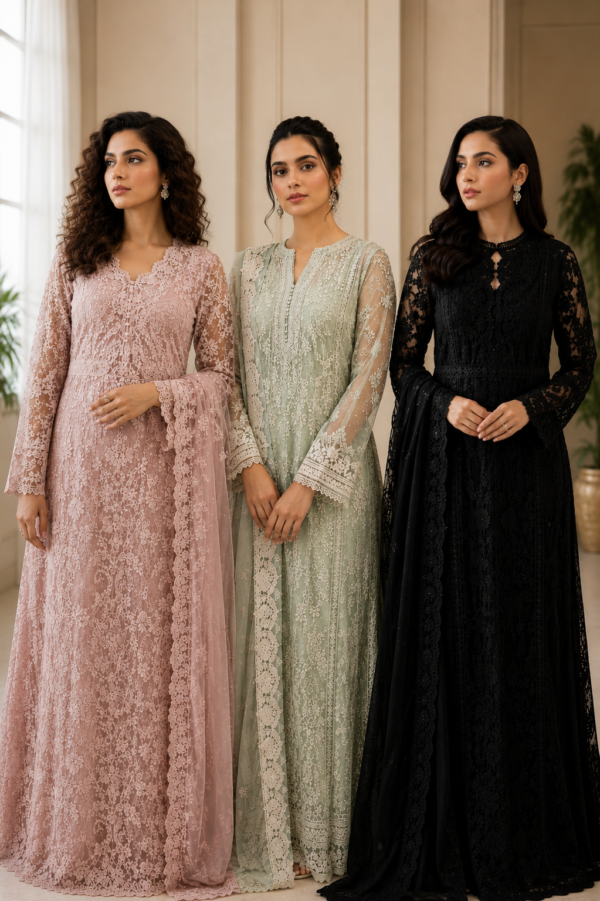
If you have ever walked through a fabric market in Karachi, Lahore, or Dubai’s textile district, you have noticed that not all lace is created equal. For a boutique owner or fashion designer, choosing the wrong lace type for a bridal silhouette can mean the difference between a breathtaking gown and a structural disaster. For a wholesale buyer, sourcing the wrong variety means expensive returns and frustrated clients.
At French Lace Fabrics (Pvt) Ltd, we have been sourcing, importing, and supplying lace for over three decades. In that time, one question has come up more than any other from our B2B clients: What exactly is the difference between Chantilly, Corded, and Guipure? This guide will answer that question definitively.
Lace originated in the royal courts of Europe in the 16th century, where it was a symbol of wealth and power. France, in particular, became a centre of exceptional lace-making, with specific regions developing their own techniques. The three most commercially significant lace types that emerged from this tradition — Chantilly, Corded, and Guipure — each carry a distinct DNA that still defines them today.
Though modern production happens primarily in China, South Korea, and select European mills, the design principles remain faithful to their French origins. When you source lace through us, you are buying into that lineage, manufactured at scale with modern precision.
Chantilly lace is the quintessential bridal lace. Named after the French town of Chantilly, it is characterised by its delicate, hexagonal net background (the ground), floral and foliate motifs, and a distinctive silky outlining thread called the cordonnet that traces the design’s edges. This outlining thread is what gives Chantilly its signature raised, light-catching definition.
Our Chantilly is sourced from Guangzhou and Keqiao mills that specialise in bridal-grade fabric. Width options range from 140cm to 300cm for gown overlays. Minimum order quantities (MOQs) start at 50 metres for wholesale buyers.
| Lace Type | Weight | Best Use | Price Tier |
| Chantilly | Lightweight | Bridal veils, evening gowns, lingerie overlays | Premium–Luxury |
| Corded | Medium–Heavy | Ball gowns, formal suiting, structured bodices | Mid–Premium |
| Guipure | Heavy | Wedding dresses, statement pieces, couture bodices | Luxury–Couture |
Corded lace is built on a more structured net base than Chantilly, with patterns that are outlined and filled using multiple threads or cords woven directly into the design. The result is a heavier, more tactile fabric that holds its shape exceptionally well. It is often confused with Chantilly because both use a net background, but Corded lace has a noticeably denser, more dimensional quality.
Ball gown bodices and structured formal wear
Jacket-style formal suits and abayas
South Asian bridal lehengas where the fabric needs to hold embellishment
Wedding dress sleeves requiring structure without stiffness
Corded lace takes hand-embroidery and mirror work better than Chantilly due to its denser weave. Boutique designers sourcing for the Pakistani bridal market often combine corded lace with zardozi work for high-value pieces.
Guipure is the boldest and most architecturally dramatic of the three. Unlike Chantilly or Corded lace, Guipure has no background net at all. The motifs — which are typically large, three-dimensional, and intricately detailed — are connected to each other by bars or brides (small connecting threads or stitched bridges). The result is a fabric with visible cut-out spaces between motifs, giving it an open, sculptural quality.
No mesh background — motifs are freestanding, connected by bars
Thick, substantial texture; holds its own shape
Large, clear motifs: flowers, medallions, leaves, geometric forms
Heavy to the touch; does not drape as softly as Chantilly
Guipure commands the highest price tier among these three lace types. We source it in cotton, polyester, and blended viscose constructions. Cotton Guipure, in particular, is in high demand for the premium bridal market in the UAE and Pakistan.
Sourcing Considerations for Wholesale Buyers
When placing orders for these lace types, there are several factors beyond aesthetics that determine the right choice for your business:
Chantilly is the most versatile for dye customisation and is available in hundreds of shades through our supplier network. Guipure, due to its construction, is harder to dye uniformly and is most commonly sourced in ivory, white, black, or pre-set palettes.
In-stock lace from our Pakistan and Dubai warehouses can be dispatched within 48 to 72 hours. Custom orders from our China offices, including exclusive colourways or pattern requests, carry a standard lead time of 25 to 35 working days depending on production schedules.
Bridal laces typically come in 120cm to 140cm widths. For full-gown construction, we recommend 150cm to 300cm scalloped-edge lace to eliminate the need for seam-heavy construction. Speak to our product specialists about width availability per construction.
Request a free sample book of our Chantilly, Corded, and Guipure collections. Contact our Pakistan or Dubai sales offices to have swatches dispatched directly to your atelier or buying office.
The right lace is never just a fabric choice — it is a structural and aesthetic decision that determines how a garment performs, how it photographs, and how it sells. As wholesale buyers and designers, understanding the specific properties of Chantilly, Corded, and Guipure lace puts you in a far stronger position to source with confidence and advise your end customers with authority.
At French Lace Fabrics (Pvt) Ltd, our sourcing team is available to guide your selection based on end-use, price bracket, and volume. We have been doing this for over 30 years — and every metre of lace we supply carries that experience behind it.