We Ship Worldwide
Need Help? email: frenchlacefabrics@gmail.com
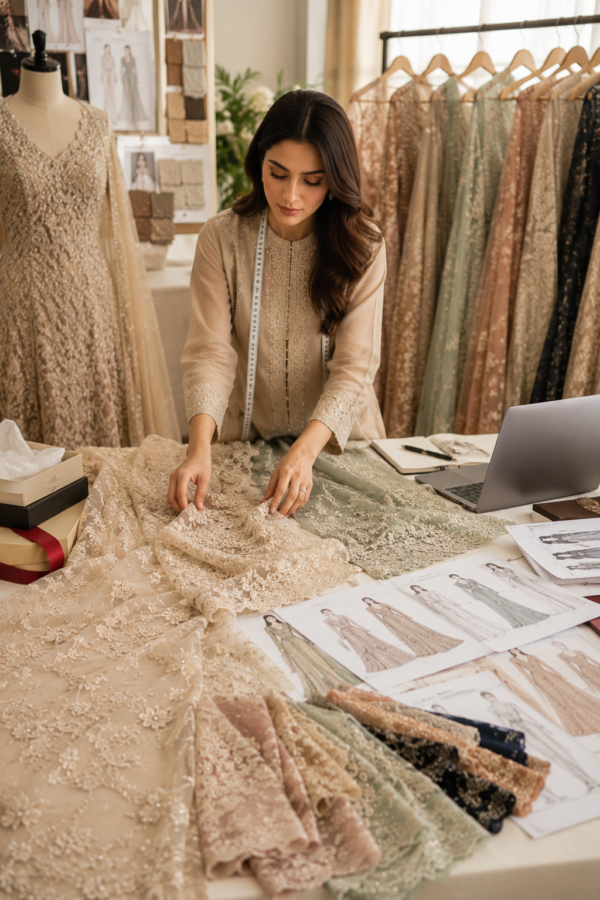
Every year, hundreds of Pakistani fashion entrepreneurs and boutique owners ask the same question: should I create my own brand, or continue retailing other labels? It is a deceptively simple question with a complex, commercially significant answer.
Private label manufacturing — where you design, brand, and sell a collection produced under your own label rather than a third party’s — has become one of the most powerful strategies available to South Asian fashion businesses. Done correctly, it transforms a retailer into a brand, unlocks significantly better margins, and creates a proprietary product that cannot be directly price-compared on the market.
Done incorrectly, it ties up capital, creates unsellable inventory, and burns relationships with production partners. In this guide, we walk through everything you need to know before making the decision.
Private label fashion refers to the production of garments or fabric collections under a brand name that is owned by the retailer or designer — not the manufacturer. The manufacturer (in this case, French Lace Fabrics’ production management arm) handles the production, quality control, and logistics. You handle the branding, marketing, and retail.
This is distinct from buying pre-made goods off a shelf and applying your label (which is called white labelling). True private label involves design input, custom colourways, exclusive fabric constructions, and bespoke packaging.
White Label = generic product + your sticker. Private Label = custom product designed to your specification + your brand identity throughout.
When you retail a third-party brand, your margin is constrained by the wholesale price you paid. When you produce your own label, your cost is the production cost — and you set the retail price. For premium and bridal categories in Pakistan and the UAE, private label margins typically run 50% to 70%, compared to 25% to 35% for bought-in branded goods.
In an era of social media commerce, exclusivity sells. A boutique that carries the same brands as 20 other stores on the same street has no defensible differentiation. A boutique with its own private label collection — its own prints, its own silhouettes, its own packaging — creates a reason to visit that cannot be replicated.
A business that owns its own labels is worth significantly more than one that distributes other people’s goods. If you ever plan to scale, seek investment, or sell your business, a proprietary brand is a transferable asset. A distribution arrangement is not.
Private label gives you the ability to respond to your specific market. If your customers want pastel chiffon for this Eid and heavy embellished net for the wedding season, you can design and produce exactly that — rather than working with whatever a national brand’s buying team has decided to offer.
Private label is not the right strategy for every business at every stage. Here is an honest assessment framework:
| ✅ Right for Private Label If… | ⚠️ Not Ready Yet If… |
| You have a consistent customer base with repeat purchase behaviour | You are still testing whether your market niche has demand |
| You have capital to invest in a minimum 200–500m first production run | Your cash flow is irregular or you cannot absorb unsold inventory |
| You have a clear aesthetic vision for your brand | You have not clearly defined your target customer |
| You have or can access a production partner you trust | You have no existing relationship with a reliable manufacturer |
| You sell at price points that support premium margins (PKR 8,000+) | You compete primarily on price in a crowded low-margin category |
Before any fabric is sourced, you need a collection brief. This includes your target customer profile, the occasion category (bridal, formal, casual, festive), your price architecture (entry, core, premium lines), and an initial colourway palette. Your brief does not need to be a professional design document — it can be a mood board and a conversation. Our design consultants work with buyers at all stages of brand maturity.
This is where French Lace Fabrics’ network adds the most value. Based on your brief, we present fabric options from our current inventory and from our China sourcing network. For private label, we can source exclusive fabric constructions — meaning fabrics that are not available to other buyers in your market — giving your collection a genuine point of difference.
Fabric samples are produced and dispatched to your design or production team for approval. For clients without in-house tailoring, we can facilitate sampling through our network of pattern-makers and stitching units. At this stage, length, drape, colour, and embellishment options are finalised.
Step 4: Production Order and QC
Once samples are approved, your production order is placed. Our QC team oversees production at the source, with inspection reports issued at each stage. For Pakistan-based clients, goods are typically delivered to your warehouse in Karachi or Lahore. UAE clients receive delivery via our Dubai Trade Office.
Step 5: Branding and Packaging
We assist clients with the textile component of branding: custom woven labels, hang tags, fabric composition cards, and branded packaging sourced from our China network. Full printing and packaging solutions are available at competitive rates for orders above a minimum threshold.
From initial brief to finished, packaged product in your warehouse: 60 to 90 days for a standard first collection. Subsequent collections, once supplier relationships and approvals are established, run on 40 to 60-day cycles.
Private label is an investment, not an expense. Here is a realistic framework for a first 300-piece bridal/formal collection using premium fabrics:
At a 300-piece run with a PKR 12,000 production cost and a PKR 32,000 retail price, your gross margin is approximately 62% before overheads. Compare that to retailing a branded article at 28% margin.
Ready to explore private label for your brand? Contact our Pakistan or UAE sales team for a confidential consultation. We work with brands at all stages — from boutique designers launching their first collection to established retailers building a proprietary line.
Private label fashion is not for every business — but for those who are ready, it is one of the most transformative decisions a fashion entrepreneur can make. It shifts you from competing on someone else’s product to owning your own market position.
At French Lace Fabrics (Pvt) Ltd, we have supported the launch and growth of private label collections across Pakistan and the UAE. Our vertically integrated model — from sourcing in China to warehousing in Dubai and Pakistan — means you have a single, accountable partner for the entire production journey.